Spray bottles are widely used across cosmetic, personal care and household product categories because they offer convenient, controlled application. However, choosing the right packaging involves more than selecting a bottle and sprayer. The container, dispensing mechanism, material and closure must work together to suit the formulation and intended use.
For brands evaluating spray bottle packaging, the key considerations include spray pattern, dispensing output, bottle capacity, product compatibility and ease of use. As part of a broader bottle packaging strategy, selecting the right spray format helps businesses balance product functionality, presentation and production requirements.
What Is Spray Bottle Packaging?
Spray bottle packaging combines a container with a dispensing mechanism designed to release liquid as a mist or directed spray. It is used for products ranging from facial mists and haircare formulations to household cleaning solutions.
A typical spray packaging system includes:
- Bottle: Holds the formulation and determines capacity, shape and material.
- Spray pump: Draws liquid from the container and delivers it through the nozzle.
- Actuator and nozzle: Control how the product is dispensed and the resulting spray pattern.
- Dip tube: Extends into the liquid to supply the dispensing mechanism.
- Closure: Secures the sprayer to the bottle and supports a suitable seal.
The exact configuration depends on the formulation, required output and application. A fine-mist sprayer designed for facial toner, for example, may not be suitable for a household cleaner requiring broader coverage.
Types of Spray Bottle Packaging
Different spray mechanisms are designed for different dispensing requirements. Understanding their differences helps brands select a suitable packaging format.
Fine Mist Spray Bottles
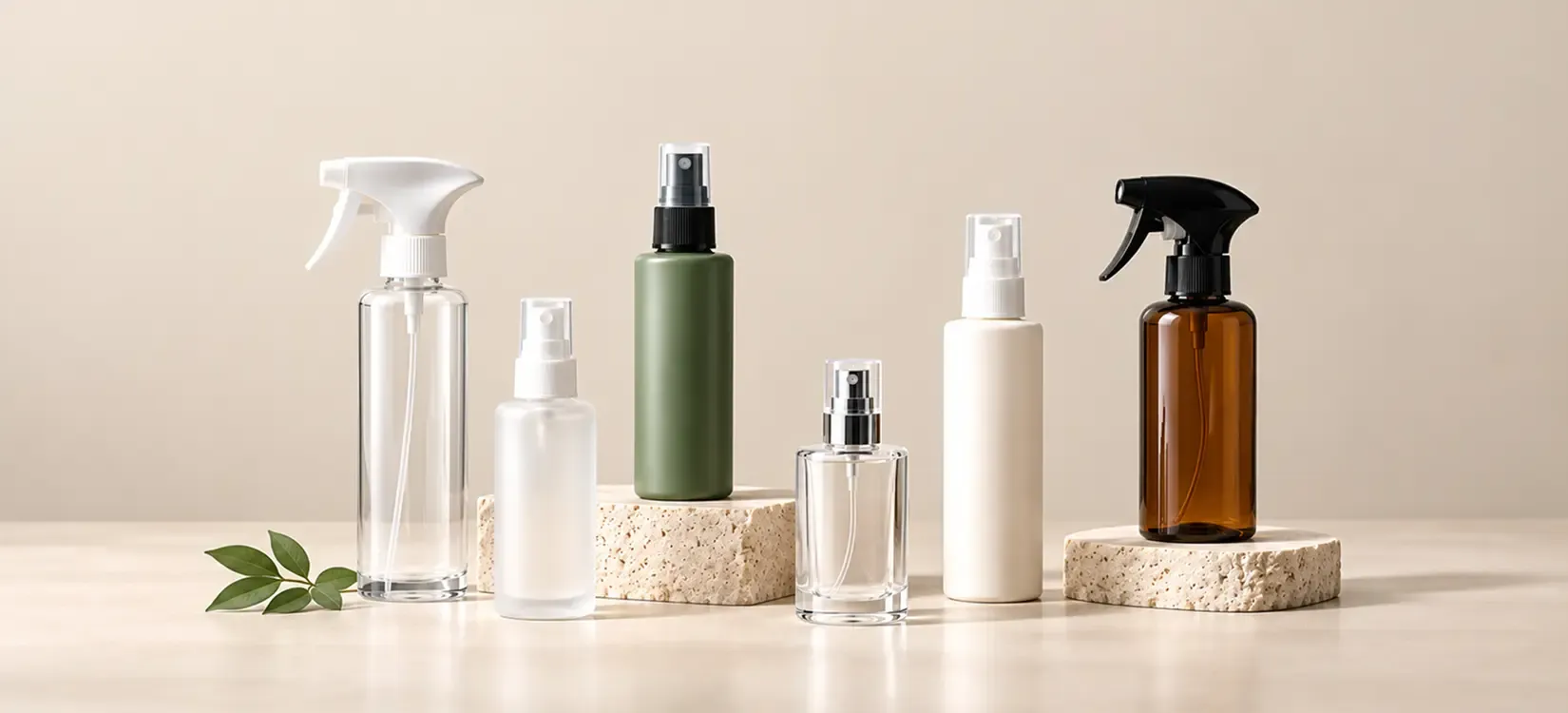
Fine-mist sprayers distribute liquid as small droplets for a light, even application. They are commonly used for facial mists, toners, body sprays, fragrances and selected haircare products.
CasePak offers mist sprayers for applications such as fragrances, toners and light skincare products.
When selecting a fine-mist sprayer, consider the formulation's viscosity, required spray output, nozzle performance and compatibility with the bottle.
Trigger Spray Bottles
Trigger sprayers use a hand-operated trigger to dispense liquid through a nozzle. Their ergonomic design makes them suitable for applications requiring repeated spraying or coverage across a larger surface.
Common applications include household cleaners, surface-care products and selected personal care or industrial formulations.
CasePak's trigger sprayer with shroud is designed for household cleaners, industrial chemicals and personal care sprays. The shroud provides additional nozzle protection.
Continuous Spray Bottles
Continuous spray systems are designed to deliver a sustained or repeated spray with minimal interruption, depending on the mechanism. They may be considered for certain haircare, beauty and personal care applications where even distribution is required.
However, continuous spray bottles should not be treated as interchangeable with standard fine-mist or trigger systems. Brands should confirm availability, dispensing performance and formulation compatibility with their packaging supplier.
Specialty Spray Bottles
Some products require application-specific dispensing systems. For example, nasal and oral sprayers use specialised nozzles designed for targeted delivery.
CasePak lists nasal and oral sprayers within its dispensing range. These should be evaluated according to the intended application and applicable product requirements.
Spray Bottle Packaging for Different Industries
The right spray format depends on how the product is applied, its formulation and the performance expected from the dispensing system.
Cosmetic and Beauty Products
Cosmetic brands use spray packaging for facial mists, toners, fragrances and other compatible liquid formulations.
Fine-mist sprayers are often preferred when the product needs to be distributed evenly across the skin or hair. The bottle's appearance, weight, nozzle performance and compatibility with the formulation are also important considerations.
Personal Care Products
Personal care applications include body sprays, haircare products and grooming formulations.
The dispensing mechanism should provide the required coverage without clogging or inconsistent output. Brands should test the complete package with the intended formulation, especially when the product contains oils, fragrances or other ingredients that may affect component performance.
Household Products
Household spray bottles are commonly used for surface cleaners, cleaning solutions and other home-care products.
Trigger sprayers can offer convenient handling and controlled application. For these products, material compatibility, chemical resistance, ergonomic use and leak resistance are particularly important.
Other Applications
Spray systems are also used in selected industrial and healthcare applications. These require additional attention to formulation compatibility, dispensing precision and the intended use of the product.
The packaging specification should be based on the application rather than assuming that one sprayer works across all industries.
Common Materials Used for Spray Bottle Packaging
The bottle material influences weight, durability, appearance and compatibility with the formulation.
Plastic Spray Bottles
Plastic is widely used for spray bottle packaging because it supports different shapes, capacities and closure configurations.
Common materials include:
- PET: Often selected for its clarity and lightweight construction.
- HDPE: Commonly used where durability and chemical resistance are important.
- PP: Frequently used for dispensing components and closures.
The most suitable material depends on the product's ingredients, storage conditions and required packaging performance. Brands should evaluate the bottle and sprayer as a complete system rather than selecting each component independently.
Plastic also supports a range of colour and decoration options, although the available choices depend on the product and manufacturing process.
Other Materials
Glass may be suitable for certain fragrance and cosmetic applications where product presentation is a priority. However, weight, breakage risk and compatibility with the sprayer and closure need to be considered.
Not every material is appropriate for every formulation. Compatibility testing should guide the final decision.
How to Choose the Right Spray Bottle Packaging?
Selecting a suitable spray bottle requires a balance between formulation requirements, dispensing performance and commercial considerations.
1. Consider the Product Formulation
Start by evaluating the liquid's viscosity, ingredients and storage requirements. A lightweight toner may work well with a fine-mist sprayer, while a household cleaning solution may require a trigger mechanism.
Formulations containing oils, solvents or other potentially reactive ingredients need particular attention to material and component compatibility.
2. Choose the Right Spray Mechanism
The mechanism should match the desired application.
- Fine mist: Suitable for compatible facial mists, toners and fragrance products.
- Trigger spray: Suitable for household cleaners and products requiring directed coverage.
- Specialty sprayers: Used where a particular application or dispensing requirement calls for a dedicated system.
Spray output, droplet distribution and consistency should be evaluated with the actual product.
3. Select the Appropriate Bottle Size
Bottle capacity should reflect product volume, frequency of use, portability and distribution requirements.
Smaller bottles may suit travel-oriented products or products used in limited quantities. Larger bottles may be more practical for frequently used household formulations.
The bottle's dimensions should also suit storage, labelling, filling and transportation requirements.
4. Consider Material Compatibility
The container, dip tube, nozzle and seals may come into contact with the formulation. Each component must be suitable for the product and intended storage conditions.
Testing can help identify issues such as material changes, leakage, clogging or inconsistent dispensing before the packaging enters commercial production.
5. Evaluate Closure and Leak Resistance
Leakage can create product loss and handling problems during storage and transportation. The sprayer must fit the bottle neck correctly and provide a suitable seal.
For products transported over long distances, brands should evaluate the complete package under relevant handling and shipping conditions.
6. Consider Branding and Customisation
Packaging appearance contributes to product presentation. Depending on the bottle and supplier, brands may explore different shapes, sizes, colours, finishes and decoration options.
However, customisation should not compromise stability, usability or the performance of the dispensing mechanism.
Spray Bottle vs Other Bottle Packaging Options
Spray bottles are one of several formats available within bottle packaging. The right option depends on how the product needs to be dispensed.
| Packaging Format | Best Suited For |
|---|---|
| Spray bottle | Products requiring mist or directed spray application |
| Pump bottle | Controlled dispensing of lotions and compatible liquids |
| Dropper bottle | Small-volume, precision dispensing |
| Squeeze bottle | Products dispensed by applying pressure to the container |
| Standard bottle with closure | Products poured or dispensed manually |
For example, a facial toner may benefit from a fine-mist sprayer, while a thicker lotion may be better suited to a pump bottle. A product designed for pouring may not need a spray mechanism at all.
The packaging format should be selected according to formulation and usage requirements, not appearance alone.
Custom Spray Bottle Packaging Solutions
Customisation can help brands align packaging with their product specifications and visual identity. It may involve the bottle, sprayer, closure and other compatible components.
Bottle Shape and Size
Bottle dimensions influence capacity, grip, stability, storage and transportation. The selected design should also work with the intended dispensing mechanism and filling process.
Colour and Finish
Colour and finish can help distinguish product ranges and reinforce brand identity. Available options depend on the material and supplier's capabilities.
Spray Pump Selection
The spray pump should deliver the required output and spray pattern consistently. Brands should evaluate actuation, nozzle performance and formulation compatibility before finalising a component.
Closure and Component Compatibility
The bottle neck, sprayer, dip tube and sealing components must fit and function together. A mismatch can affect dispensing performance or lead to leakage.
Printing and Branding
Labels and other decoration options can support product identification and brand presentation. The method should suit the bottle's shape, material and intended handling conditions.
Sampling and Evaluation
Where sample requests are available, evaluating the actual components before bulk procurement can help brands assess fit, dispensing performance and appearance. CasePak's product pages provide options to request samples or quotes for listed products.
Benefits of Choosing the Right Spray Bottle Packaging
A well-matched spray packaging system can support:
Appropriate dispensing: Delivers the product in the intended spray pattern.
- Ease of use: Makes application convenient for the intended user.
- Product protection: Helps secure the formulation during storage and handling.
- Consistent performance: Supports reliable dispensing throughout use.
- Brand presentation: Aligns packaging appearance with product positioning.
- Transportation efficiency: Helps reduce leakage and handling issues when properly specified.
These benefits depend on the complete packaging design, formulation compatibility and appropriate testing.
Spray Bottle Packaging for Cosmetic vs Household Products
Although both categories use spray mechanisms, their requirements can differ significantly.
| Factor | Cosmetic Products | Household Products |
|---|---|---|
| Typical applications | Facial mists, toners, body sprays and hair products | Surface cleaners and home-care solutions |
| Dispensing | Often fine mist or application-specific spray | Often trigger or directed spray |
| User experience | Application control and product presentation | Ergonomics and surface coverage |
| Compatibility | Formulation and component compatibility | Formulation compatibility and durability |
| Branding | Beauty-focused appearance and finish | Functional and brand-specific design |
These are general patterns rather than fixed rules. The final choice should be based on the product's formulation, intended use and dispensing requirements.
How to Select Spray Bottle Packaging for Your Product?
Use this checklist when evaluating packaging options with a supplier:
- Product formulation: Identify viscosity, ingredients and storage requirements.
- Desired spray pattern: Determine whether the product needs a fine mist, directed spray or specialised dispensing.
- Bottle capacity: Match volume to usage, portability and distribution.
- Material compatibility: Confirm suitability of the bottle and dispensing components.
- Pump and actuator requirements: Evaluate output, nozzle performance and ease of use.
- Closure requirements: Check fit, sealing and leak resistance.
- Branding and customisation: Review available shapes, colours and finishes.
Transportation and storage: Consider durability, dimensions and handling conditions.
This process helps brands define clear packaging specifications before placing a bulk order.
Why Choose CasePak for Spray Bottle Packaging?
CasePak offers bottle packaging and dispensing components for applications across personal care, cosmetics, household cleaning and other industries.
Its listed dispensing range includes fine-mist sprayers, trigger sprayers and specialised nasal and oral sprayers. The company also provides bottle options and supports packaging customisation, subject to product specifications and availability.
When evaluating a spray packaging solution, brands should confirm:
- Bottle material, capacity and dimensions
- Compatible sprayer and closure options
- Dispensing output and intended application
- Formulation compatibility
- Customisation availability
- Sample, quotation and supply requirements
Choosing the right combination of bottle and dispensing mechanism can help businesses meet product requirements while maintaining consistent packaging performance.
Looking for custom spray bottle packaging? Explore CasePak's spray and dispensing solutions or browse its bottle packaging range to discuss the options suited to your product.